The khadi spirit

If we have the khadi spirit in us,
we would surround ourselves with simplicity
in every walk of life

Mahatma Gandhi

Made by Masters

Plants, Minerals. Sunlight. Rainfall. Time

The knowledge behind the work

THE CLOTH

Textile History dates back to the beginning of human civilization. Hartwick Atelier specializes in hand spun and handwoven fabrics, natural and ayurvedic dyes, and exquisite heritage handwork.

THE KNOWLEDGE

These artisanal techniques rely on rare knowledge and the natural cycles of the sun, wind and rain.

THE HANDWORK

Each handcrafted piece in the collection is a glimpse into the rich history, intricate process, and generations of skill that have gone into its creation.

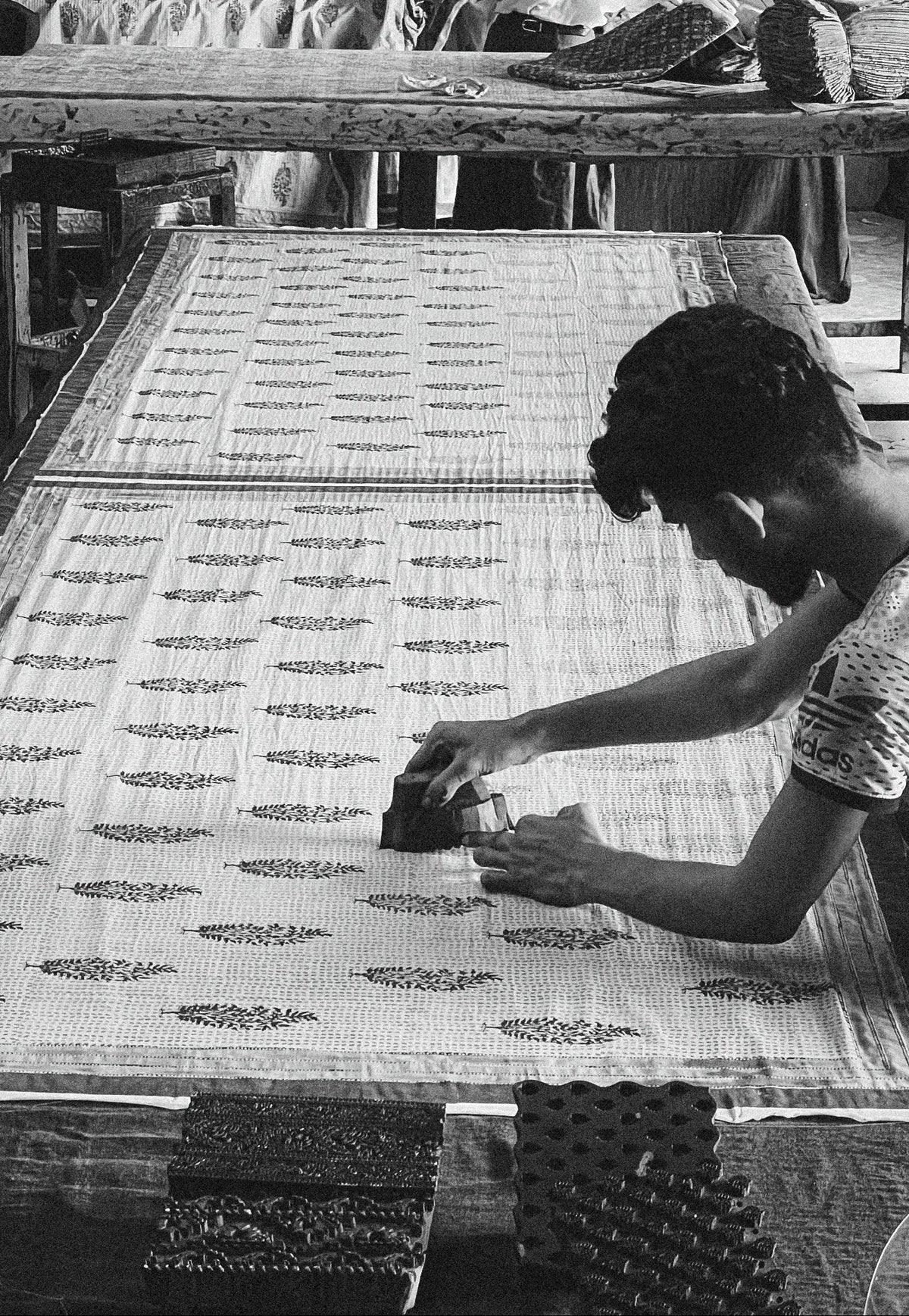
Photographs laid one over another: a printer pressing a carved block onto cloth on a long table, over sheets of green and earth-red paper

Masters hold knowledge developed over centuries in alignment with the natural world, with dyes drawn from plants and minerals and processes governed by sunlight, rainfall and time. This knowledge is held in families, communities and the hands of each Master.

We are concerned with the environmental and human costs of industrial textile production. Handspun, handwoven and natural-dye fabrics connect us to artisans, often in communities with a direct connection to the agricultural production of the fibres and deep, generational handcraft knowledge.

What we put on our bodies has consequences for the planet and the people who make it. Every Hartwick piece ships with its Lot number, its Origin story, and the name of the artisan who made it.

A glossary of
heritage techniques

Explore the knowledge behind the work. Open a technique to read its story and watch the process.

  1. A Master at work beside the handloom

    Handspun and handwoven

    Khadi is cloth made from yarn spun by hand and woven on a handloom. Spinning and weaving both shape its character. Small variations in the yarn and weave record the work of the hands that made it.

  2. A charkha, the spinning wheel, standing in the yard

    From fibre to yarn

    Natural fibres are drawn out and twisted together by hand to form a yarn. The spinner controls the thickness and twist as the fibre passes through their fingers. The yarn is then prepared for weaving.

  3. Warp threads running into the loom, seen close

    Working at the loom

    At the handloom, the weaver brings yarns together to make cloth. Preparing and arranging the yarn is part of the work, alongside the repeated movements of weaving. Different yarns and structures give the finished cloth its particular texture and drape.

  4. The raised printing face of a carved wooden block

    Layer by layer, colour by colour

    The printer places a carved wooden block onto the cloth, then repeats the impression to build the pattern. Each colour is applied in its own pass. Small variations in placement and colour are part of this hand process.

  5. A carver cutting the pattern with a fine chisel
    Transcript

    A silent film. The carver works a small chisel with a mallet, cutting away the ground around the raised design so that the lines of the pattern and the lettering of the Hartwick mark stand proud of the block. Finished blocks are stacked behind the work.

    Carving the Hartwick block. Silent film.

    The tools behind the pattern

    A design is traced onto a prepared wooden block. Using small chisels, the carver removes the spaces around it, leaving the printing surface raised. A pattern with several colours needs a corresponding set of blocks, used together by the printer.

  6. Blue-dyed yarn wound on bobbins

    Colour from plants and minerals

    The original Hartwick archive describes dyes made with materials including indigo, turmeric, pomegranate, iron and clay. Preparing the colour and working it into the cloth require close attention to the material. Tonal variation gives the dyed fabric its individual character.

  7. Printing, dyeing, washing and rest

    Ajrakh combines carved-block printing and resist-dyeing processes. Patterns are built through successive stages, with washing and resting between parts of the work. The archive shows colour preparation, printing and cloth drying outdoors: different moments within one extended process.

  8. A handwoven ikat shirt worn with a khadi skirt

    Tied and dyed before weaving

    In ikat, the pattern begins in the yarn. Selected areas are bound to resist the dye before the yarns are woven into cloth. The pattern emerges at the loom, bringing the work of dyeing and weaving together.

  9. A gota patti belt, ribbon applied and stitched by hand

    Applied and stitched by hand

    Gota Patti uses pieces of decorative ribbon applied to cloth and secured with stitching. The arrangement of these small elements builds the larger motif. Close-up photography and film can show the cutting, placement and detail of the handwork.

  10. A handwoven jamdani shirt

    Motifs within the weave

    Jamdani patterns are introduced by hand during weaving. The motifs are part of the cloth as it is made, rather than a print applied afterwards. A close view of the loom makes the relationship between the fine ground and the pattern visible.

  11. Pattern through weaving

    The Hartwick archive describes decorative brocade woven in Varanasi, often using coloured silks and zari threads. Additional pattern threads build the design within the weave. Show both the loom and the cloth closely, so the construction and surface can be understood.

Handwork naturally results in variations

We cherish these nuances for their human touch

A spinner's hands drawing out the thread
01 / HandspinningA moment held.
A handloom under a blue awning, the warp wound on the beam
02 / HandweavingA process in motion.
The block carver's workshop in low light

From the Hartwick archive

At the printing table

The work continues

Stories of the people, their materials and the knowledge they carry. Follow the work through the Journal.

Read the Journal